
A controlled exercise — here is exactly what we did
This article documents a small, controlled improvement exercise. The "page" we optimize is a piece of demo copy we wrote for this purpose — the homepage text of an imaginary bakery — and we say so openly rather than presenting it as a client case study. Everything below is reproducible: you can paste the same draft text into the same tools and watch the same numbers change.
Why a synthetic example instead of a real website? Because an honest before-and-after needs a stable baseline. Real sites change, rankings lag by weeks and outside factors contaminate the result. A fixed draft lets us isolate one variable at a time and measure what actually changed: the snippet fields and the topical focus of the copy. What we deliberately do not claim anywhere in this article: that these edits improve rankings. Nobody can measure that without a live site and months of Search Console data, and we will not invent it.
The baseline: a weak but very common draft
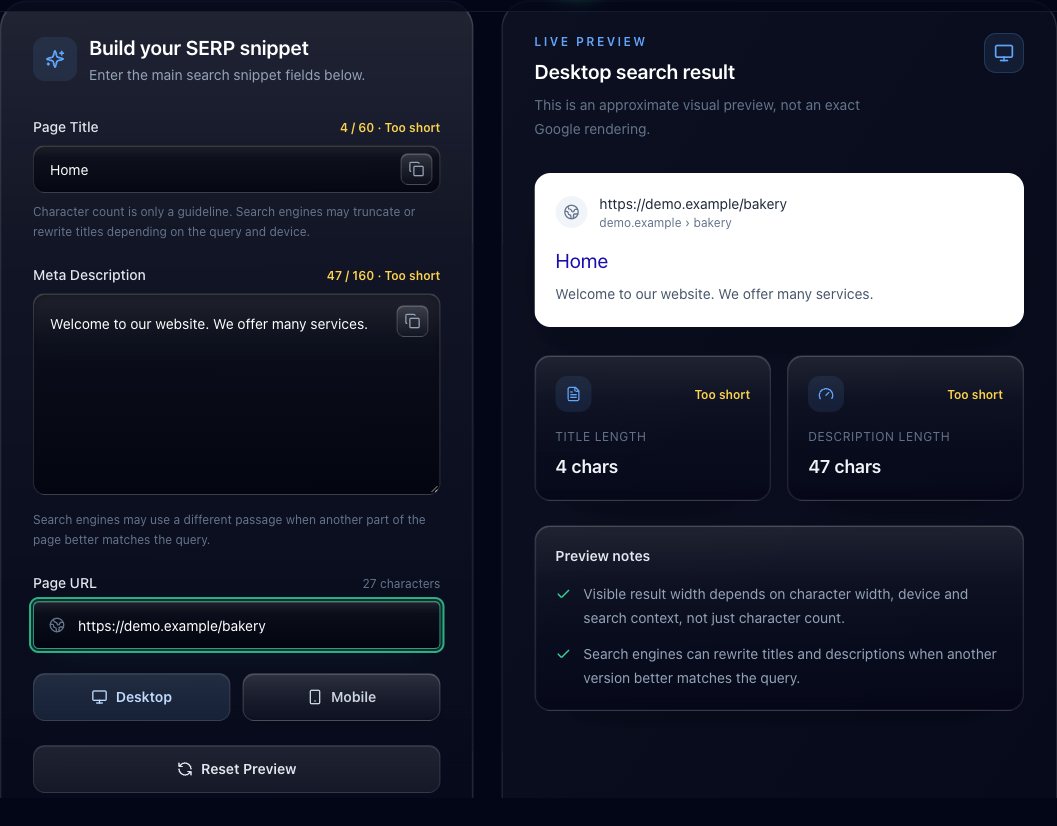
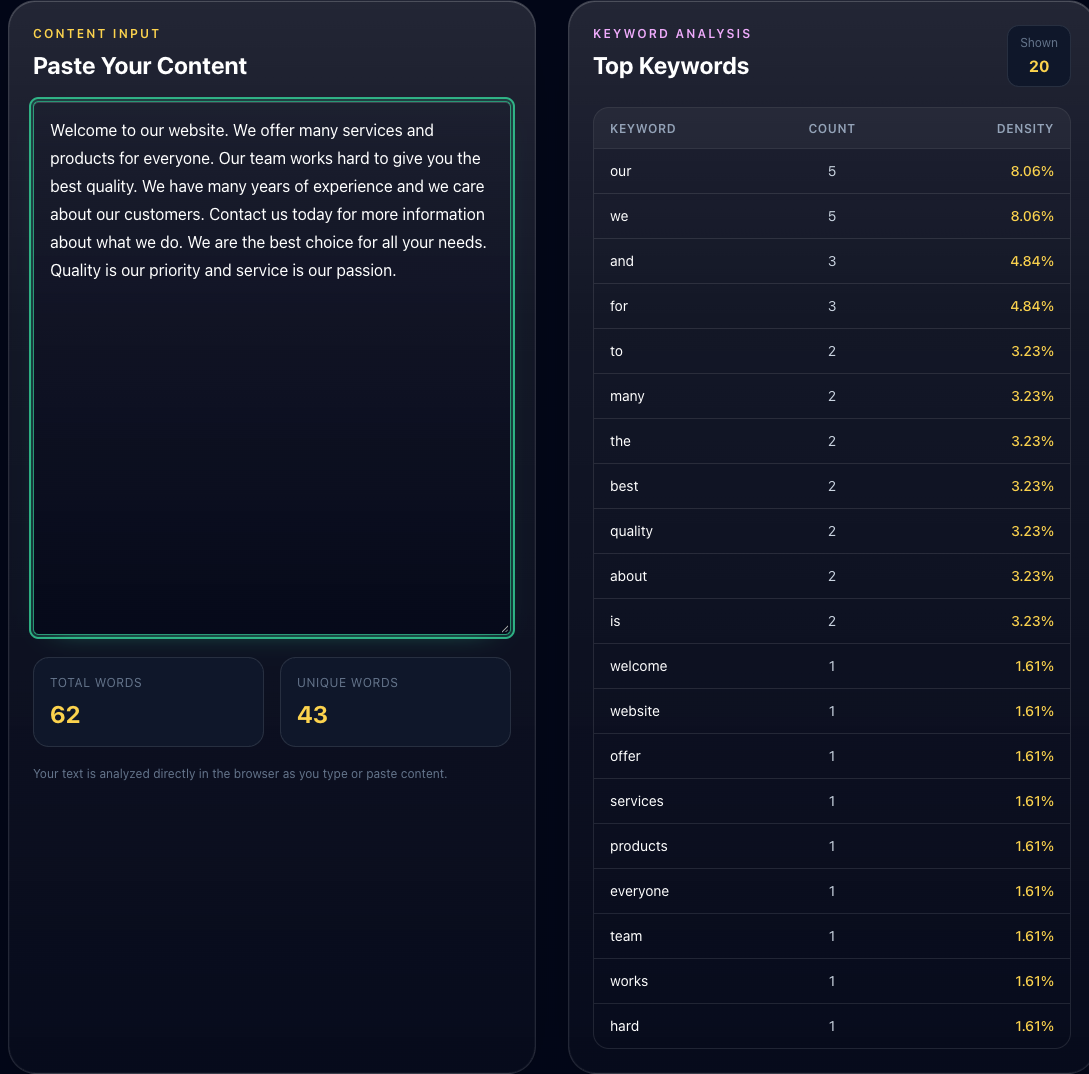
Our starting point combines three weaknesses that real audits encounter constantly. The title tag is "Home" — four characters that say nothing. The meta description is "Welcome to our website. We offer many services." — 47 characters of filler. The body copy talks about quality, experience and passion without once naming a product, a place or an audience.
The SERP Snippet Preview scores both fields immediately: title 4/60, "Too short"; description 47/160, "Too short". The rendered preview shows what a searcher would actually see — a meaningless blue "Home" above a sentence that gives nobody a reason to click.
The Keyword Density Checker makes the second problem measurable. Across the 62-word draft, the most frequent content words are "our" (8.06%), "we" (8.06%) and "and" (4.84%). The text never settles on a topic: there is no term a search engine could use to answer the basic question "what is this page about?"
The rewrite: name the thing, the place and the offer
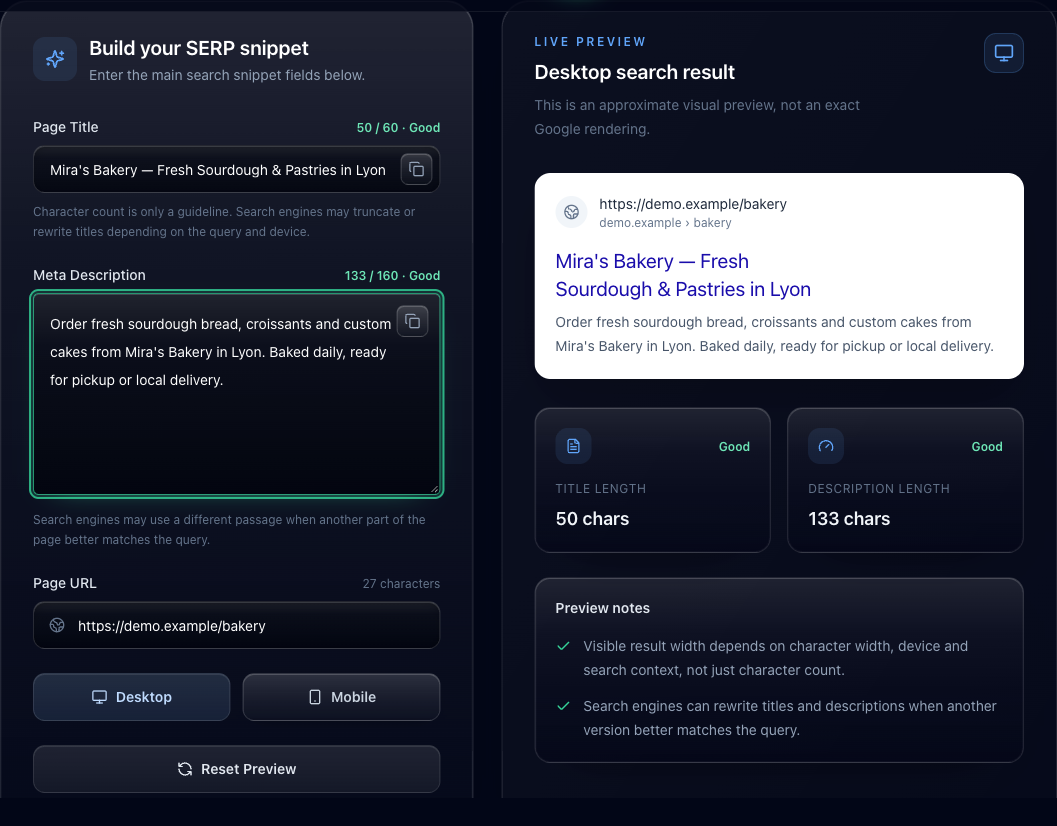
The rewrite applies three rules. First, the title names the brand, the core offer and the location — "Mira's Bakery — Fresh Sourdough & Pastries in Lyon". Second, the description answers the questions a searcher actually has: what is sold, where, and what to do next. Third, the body copy swaps generic claims for concrete, verifiable details: what is baked, when the shop opens, how ordering works.
None of this is keyword research wizardry. It is simply writing that assumes the reader cannot see the rest of the site. A title that works as a standalone answer to "what and where is this?" will almost always fall inside the length guidelines automatically.
After: the same tools, measured again
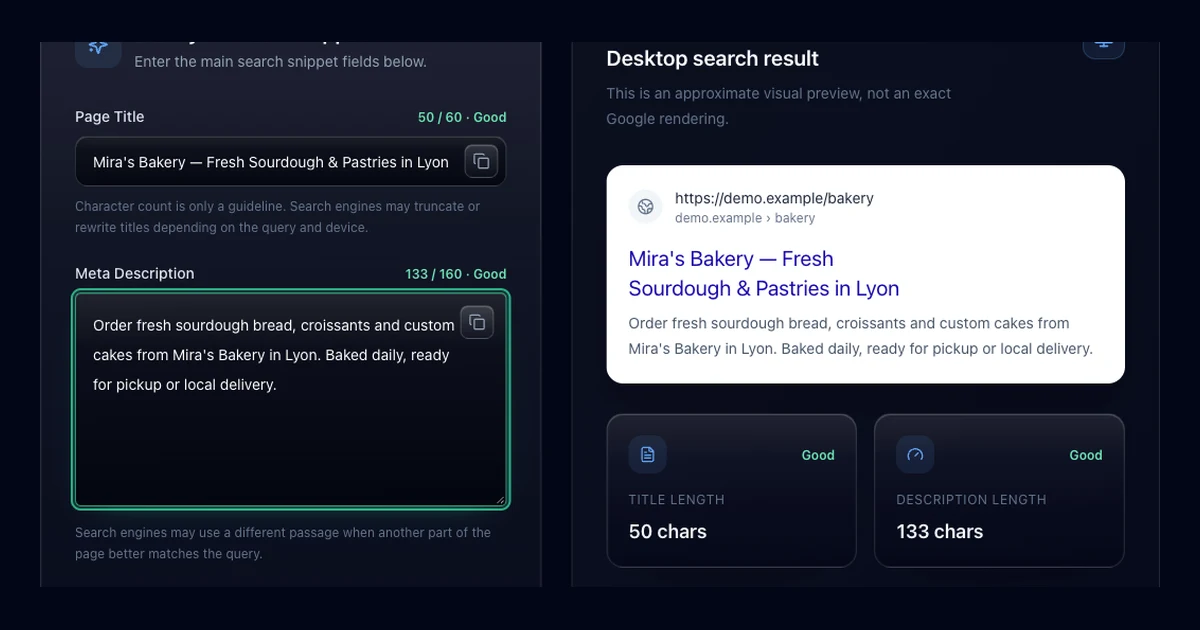
Re-running the SERP Snippet Preview on the new fields: title 50/60 and description 133/160, both rated "Good". The preview now reads like a result a hungry person in Lyon would click — brand, offer, location and a concrete call to action, all visible without truncation on desktop.
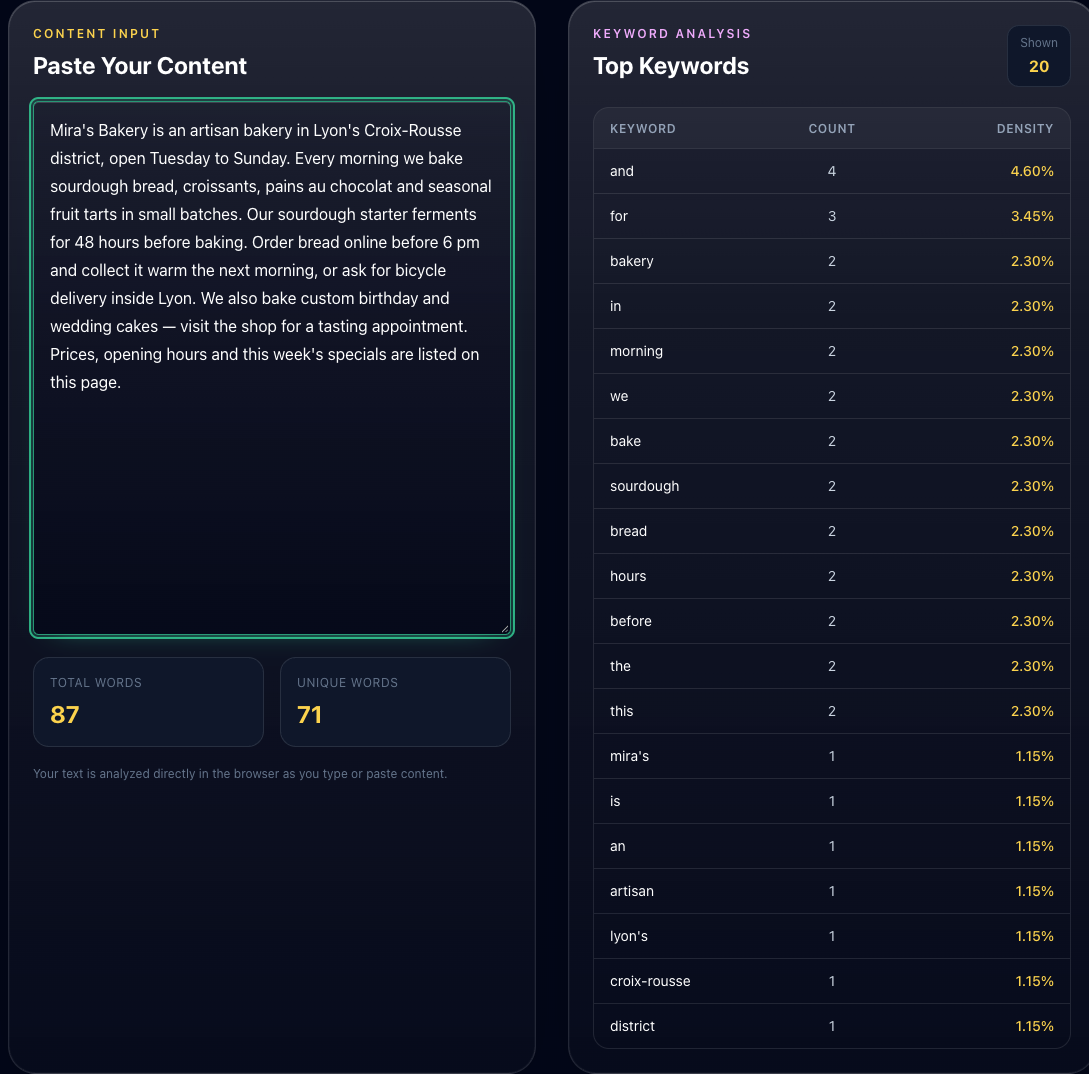
The Keyword Density Checker tells the same story for the body copy. The 87-word rewrite is led by topical terms — "bakery", "sourdough", "bread" and "bake" each at 2.30% — with the filler words pushed down the table. The text did not get longer for the sake of length; it got more specific, and the density table is how that specificity shows up in a measurement.
A caution about density numbers: 2.30% is not a target to hit, and there is no ideal percentage. We use the table only to confirm that the topic is detectable and that no single term is repeated mechanically. If a keyword appears ten times in a hundred words, the problem is the writing, not the ratio.
What this exercise does not prove
These measurements show that the snippet fields fall inside sensible ranges and that the copy now has a detectable topic. They say nothing about rankings, click-through rate or conversions. Snippet previews are approximations — Google rewrites titles and descriptions when it judges another part of the page more relevant to the query — and the tool says so on the page.
The honest claim is narrower and more useful: the page went from failing basic, checkable criteria to passing them, and every step can be verified by re-running the same free tools. On a live site, the next measurement would come from Search Console — impressions and click-through rate on the rewritten page, weeks later, not from any editor or preview.
Reuse this workflow on your own pages
Pick one page that matters. Paste its current title and description into the SERP Snippet Preview and note the counters. Paste the visible body copy into the Keyword Density Checker and ask the uncomfortable question: do the top five words name my topic? Rewrite for specificity — brand, offer, place, action — then measure again. Finish by generating standards-compliant tags with the Meta Tag Generator so the new snippet ships in valid HTML.
Small, verified improvements on real pages beat large imagined ones. That is the entire method.
Put this guide into practice
Open the related LifeSeos tool and apply what you just learned to your own website.
SERP Snippet Preview